
For the first time in over 50 years, we’ve returned humans to the Moon. I can’t be the only one who had BIG feelings about it.
Through NASA’s Artemis Program, the goal isn’t just to visit, but to stay. With upcoming missions building toward a sustained human presence on the lunar surface, the Moon is once again becoming a place of active exploration, innovation, and big questions.
But those questions aren’t just for astronauts and engineers; they’re for all of us.
The Real Challenge of Living on the Moon
It’s easy to picture astronauts walking across the lunar surface. It’s harder to imagine what it actually takes to live there.
The Moon is an extreme environment:
- No atmosphere → no air pressure, no protection
- High radiation exposure → constant bombardment from space
- Extreme temperatures → from blistering heat to deep cold in a nearly 450°F swing from day to night at the equator
- Reduced gravity → just 1/6 of what we experience on Earth
Every one of these challenges has to be solved—not hypothetically, but practically—if Artemis is going to succeed. This is where science becomes more than theory. Science means survival.
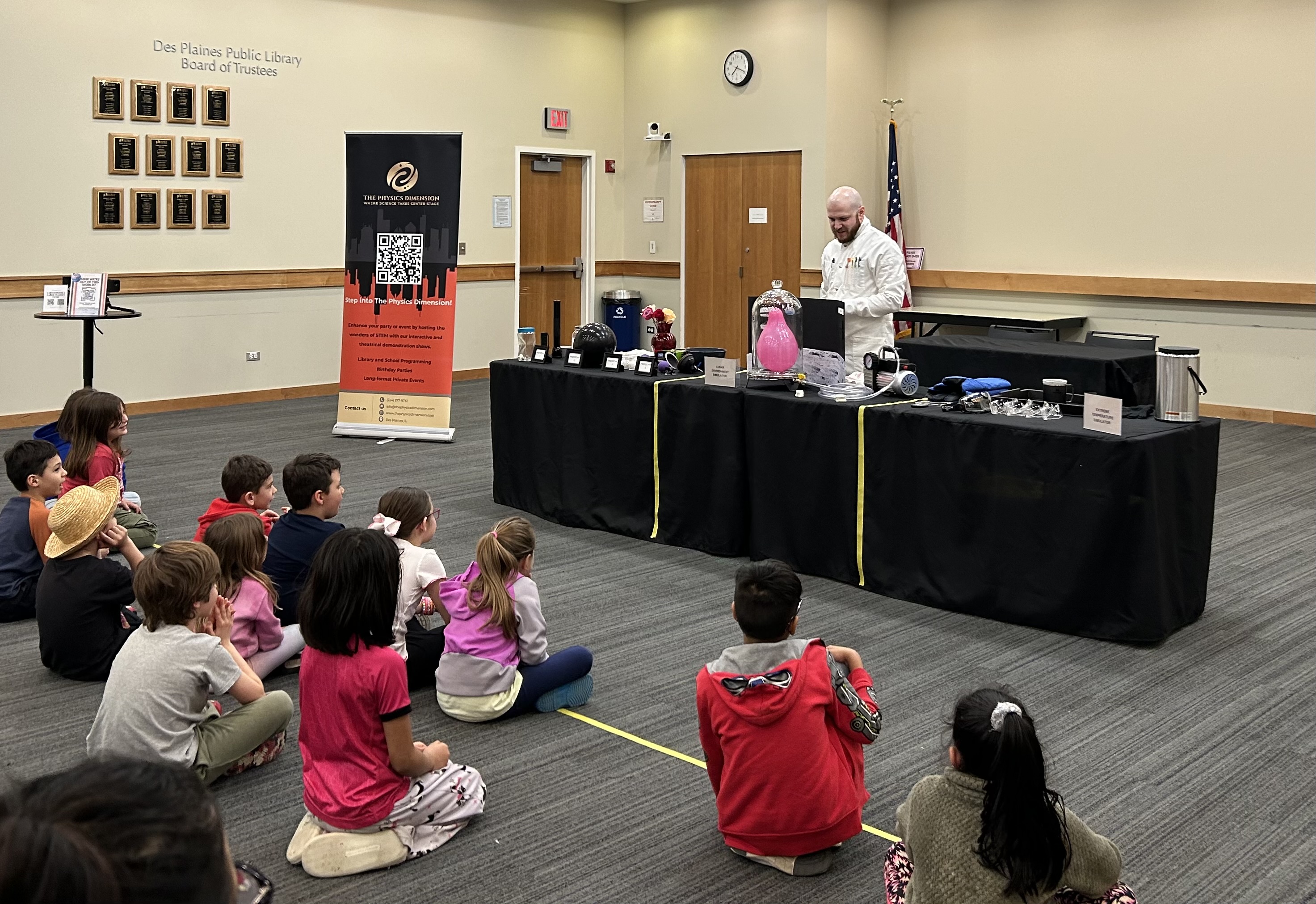
In our latest show, Surviving the Moon, we invite families to step into that challenge with a question: What would it take to survive on the Moon?
Instead of presenting answers, we explored them together.
Participants saw what happens when pressure disappears using a vacuum chamber.
They visualized invisible radiation with UV-reactive materials.
They experienced the dramatic effects of extreme cold through liquid nitrogen demonstrations.
Finally, they discovered that some of the Moon’s harshest conditions can actually enable technologies like magnetic levitation.
What stood out wasn’t just the reactions (though there were plenty of those). It was the moment when curiosity turned into understanding of why the physics matters.
Why This Matters Now
Programs like Artemis are often followed from a distance, but the science behind them becomes much more meaningful when it’s experienced up close.
Libraries, in particular, play a unique role here. They are one of the few spaces where:
- families learn together,
- questions are encouraged,
- and complex ideas can be explored without barriers.
When current events in science are brought into these spaces in a tangible way, they become personal. Programs that evolve alongside real-world missions like Artemis create an ongoing connection between global science and local communities.
As the Artemis Program continues to evolve, so are we. We’re actively developing and refining Artemis-aligned programming that can grow alongside the mission itself, bringing new challenges, new technologies, and new discoveries into the room as they happen.
That means future audiences won’t just hear about returning to the Moon; they’ll explore the same problems engineers and scientists are working on right now, through hands-on demonstrations and story-driven experiences.
Bringing Artemis down to Earth
As Artemis moves forward, the story of returning to the Moon won’t be a single moment — it will unfold over years. We’re building our programming the same way.
Our goal is to continue developing Artemis-inspired science experiences for libraries and community spaces — programs that can adapt, grow, and stay relevant as new milestones are reached.
Not everyone will build rockets or design habitats, but everyone can understand the science behind them.
When that understanding starts in a place as accessible as a library, it does something powerful: It turns a distant mission into something personal.
If your library or community space is looking to connect audiences with the science behind current missions like Artemis, we’d love to be part of that conversation.
Leave a Reply